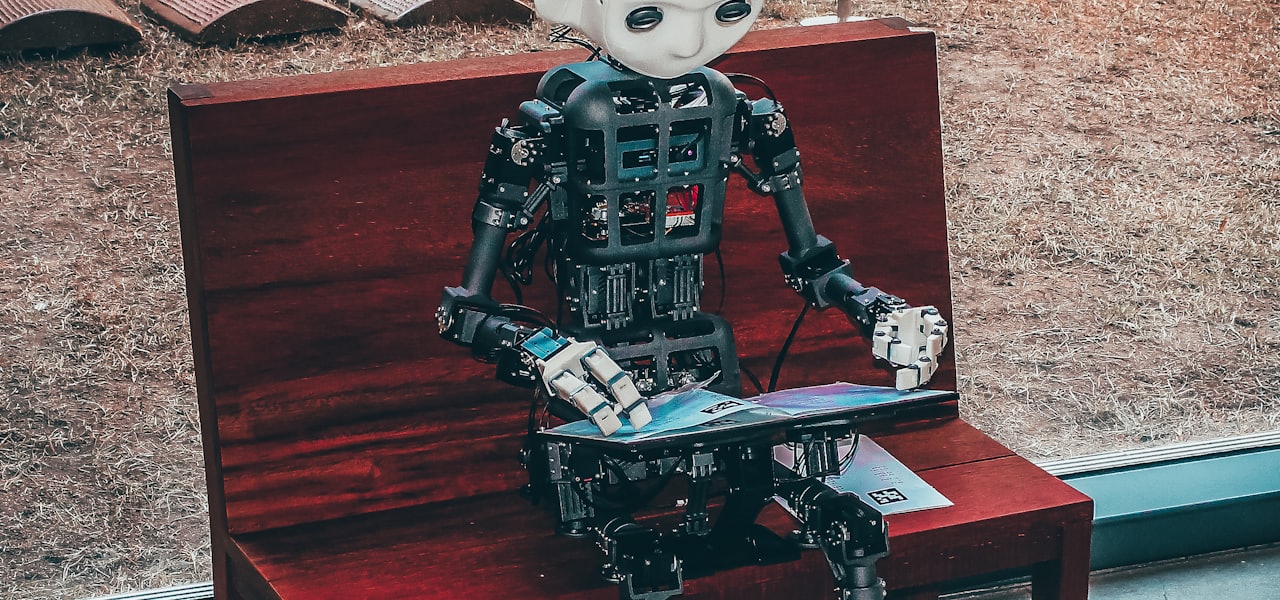
A semantic decomposition is an algorithm that breaks down the meanings of phrases or concepts into less complex concepts. The result of a semantic decomposition is a representation of meaning. This representation can be used for tasks, such as those related to artificial intelligence or machine learning. Semantic decomposition is common in natural language processing applications. The basic idea of a semantic decomposition is taken from the learning skills of adult humans, where words are explained using other words. It is based on Meaning-text theory. Meaning-text theory is used as a theoretical linguistic framework to describe the meaning of concepts with other concepts. == Background == Given that an AI does not inherently have language, it is unable to think about the meanings behind the words of a language. An artificial notion of meaning needs to be created for a strong AI to emerge. Creating an artificial representation of meaning requires the analysis of what meaning is. Many terms are associated with meaning, including semantics, pragmatics, knowledge and understanding or word sense. Each term describes a particular aspect of meaning, and contributes to a multitude of theories explaining what meaning is. These theories need to be analyzed further to develop an artificial notion of meaning best fit for our current state of knowledge. == Graph representations == Representing meaning as a graph is one of the two ways that both an AI cognition and a linguistic researcher think about meaning (connectionist view). Logicians utilize a formal representation of meaning to build upon the idea of symbolic representation, whereas description logics describe languages and the meaning of symbols. This contention between 'neat' and 'scruffy' techniques has been discussed since the 1970s. Research has so far identified semantic measures and with that word-sense disambiguation (WSD) - the differentiation of meaning of words - as the main problem of language understanding. As an AI-complete environment, WSD is a core problem of natural language understanding. AI approaches that use knowledge-given reasoning creates a notion of meaning combining the state of the art knowledge of natural meaning with the symbolic and connectionist formalization of meaning for AI. The abstract approach is shown in Figure. First, a connectionist knowledge representation is created as a semantic network consisting of concepts and their relations to serve as the basis for the representation of meaning. This graph is built out of different knowledge sources like WordNet, Wiktionary, and BabelNET. The graph is created by lexical decomposition that recursively breaks each concept semantically down into a set of semantic primes. The primes are taken from the theory of Natural Semantic Metalanguage, which has been analyzed for usefulness in formal languages. Upon this graph marker passing is used to create the dynamic part of meaning representing thoughts. The marker passing algorithm, where symbolic information is passed along relations form one concept to another, uses node and edge interpretation to guide its markers. The node and edge interpretation model is the symbolic influence of certain concepts. Future work uses the created representation of meaning to build heuristics and evaluate them through capability matching and agent planning, chatbots or other applications of natural language understanding.
Open information extraction
In natural language processing, open information extraction (OIE) is the task of generating a structured, machine-readable representation of the information in text, usually in the form of triples or n-ary propositions. == Overview == A proposition can be understood as truth-bearer, a textual expression of a potential fact (e.g., "Dante wrote the Divine Comedy"), represented in an amenable structure for computers [e.g., ("Dante", "wrote", "Divine Comedy")]. An OIE extraction normally consists of a relation and a set of arguments. For instance, ("Dante", "passed away in" "Ravenna") is a proposition formed by the relation "passed away in" and the arguments "Dante" and "Ravenna". The first argument is usually referred as the subject while the second is considered to be the object. The extraction is said to be a textual representation of a potential fact because its elements are not linked to a knowledge base. Furthermore, the factual nature of the proposition has not yet been established. In the above example, transforming the extraction into a full fledged fact would first require linking, if possible, the relation and the arguments to a knowledge base. Second, the truth of the extraction would need to be determined. In computer science transforming OIE extractions into ontological facts is known as relation extraction. In fact, OIE can be seen as the first step to a wide range of deeper text understanding tasks such as relation extraction, knowledge-base construction, question answering, semantic role labeling. The extracted propositions can also be directly used for end-user applications such as structured search (e.g., retrieve all propositions with "Dante" as subject). OIE was first introduced by TextRunner developed at the University of Washington Turing Center headed by Oren Etzioni. Other methods introduced later such as Reverb, OLLIE, ClausIE or CSD helped to shape the OIE task by characterizing some of its aspects. At a high level, all of these approaches make use of a set of patterns to generate the extractions. Depending on the particular approach, these patterns are either hand-crafted or learned. == OIE systems and contributions == Reverb suggested the necessity to produce meaningful relations to more accurately capture the information in the input text. For instance, given the sentence "Faust made a pact with the devil", it would be erroneous to just produce the extraction ("Faust", "made", "a pact") since it would not be adequately informative. A more precise extraction would be ("Faust", "made a pact with", "the devil"). Reverb also argued against the generation of overspecific relations. OLLIE stressed two important aspects for OIE. First, it pointed to the lack of factuality of the propositions. For instance, in a sentence like "If John studies hard, he will pass the exam", it would be inaccurate to consider ("John", "will pass", "the exam") as a fact. Additionally, the authors indicated that an OIE system should be able to extract non-verb mediated relations, which account for significant portion of the information expressed in natural language text. For instance, in the sentence "Obama, the former US president, was born in Hawaii", an OIE system should be able to recognize a proposition ("Obama", "is", "former US president"). ClausIE introduced the connection between grammatical clauses, propositions, and OIE extractions. The authors stated that as each grammatical clause expresses a proposition, each verb mediated proposition can be identified by solely recognizing the set of clauses expressed in each sentence. This implies that to correctly recognize the set of propositions in an input sentence, it is necessary to understand its grammatical structure. The authors studied the case in the English language that only admits seven clause types, meaning that the identification of each proposition only requires defining seven grammatical patterns. The finding also established a separation between the recognition of the propositions and its materialization. In a first step, the proposition can be identified without any consideration of its final form, in a domain-independent and unsupervised way, mostly based on linguistic principles. In a second step, the information can be represented according to the requirements of the underlying application, without conditioning the identification phase. Consider the sentence "Albert Einstein was born in Ulm and died in Princeton". The first step will recognize the two propositions ("Albert Einstein", "was born", "in Ulm") and ("Albert Einstein", "died", "in Princeton"). Once the information has been correctly identified, the propositions can take the particular form required by the underlying application [e.g., ("Albert Einstein", "was born in", "Ulm") and ("Albert Einstein", "died in", "Princeton")]. CSD introduced the idea of minimality in OIE. It considers that computers can make better use of the extractions if they are expressed in a compact way. This is especially important in sentences with subordinate clauses. In these cases, CSD suggests the generation of nested extractions. For example, consider the sentence "The Embassy said that 6,700 Americans were in Pakistan". CSD generates two extractions [i] ("6,700 Americans", "were", "in Pakistan") and [ii] ("The Embassy", "said", "that [i]"). This is usually known as reification.
Physical access
Physical access is a term in computer security that refers to the ability of people to physically gain access to a computer system. According to Gregory White, "Given physical access to an office, the knowledgeable attacker will quickly be able to find the information needed to gain access to the organization's computer systems and network." == Attacks and countermeasures == === Attacks === Physical access opens up a variety of avenues for hacking. Michael Meyers notes that "the best network software security measures can be rendered useless if you fail to physically protect your systems," since an intruder could simply walk off with a server and crack the password at his leisure. Physical access also allows hardware keyloggers to be installed. An intruder may be able to boot from a CD or other external media and then read unencrypted data on the hard drive. They may also exploit a lack of access control in the boot loader; for instance, pressing F8 while certain versions of Microsoft Windows are booting, specifying 'init=/bin/sh' as a boot parameter to Linux (usually done by editing the command line in GRUB), etc. One could also use a rogue device to access a poorly secured wireless network; if the signal were sufficiently strong, one might not even need to breach the perimeter. === Countermeasures === IT security standards in the United States typically call for physical access to be limited by locked server rooms, sign-in sheets, etc. Physical access systems and IT security systems have historically been administered by separate departments of organizations, but are increasingly being seen as having interdependent functions needing a single, converged security policy. An IT department could, for instance, check security log entries for suspicious logons occurring after business hours, and then use keycard swipe records from a building access control system to narrow down the list of suspects to those who were in the building at that time. Surveillance cameras might also be used to deter or detect unauthorized access.
Film-out
Film-out is the process in the computer graphics, video production and filmmaking disciplines of transferring images or animation from videotape or digital files to a traditional film print. Film-out is a broad term that encompasses the conversion of frame rates, color correction, as well as the actual printing, also called scannior recording. The film-out process is different depending on the regional standard of the master videotape in question – NTSC, PAL, or SECAM – or likewise on the several emerging region-independent formats of high definition video (HD video); thus each type is covered separately, taking into account regional film-out industries, methods and technical considerations. == Live action video == Many modern documentaries and low-budget films are shot on videotape or other digital video media, instead of film stock, and completed as digital video. Video production means substantially lower costs than 16 mm or 35 mm film production on all levels. Until recently, the relatively low cost of video ended when the issue of a theatrical presentation was raised, which required a print for film projection. With the growing presence of digital projection, this is becoming less of a factor. === Standard definition (SD) video === Film-out of standard-definition video – or any source that has an incompatible frame rate – is the up-conversion of video media to film for theatrical viewing. The video-to-film conversion process consists of two major steps: first, the conversion of video into digital film frames which are then stored on a computer or on HD videotape; and secondly, the printing of these digital film frames onto actual film. To understand these two steps, it is important to understand how video and film differ. Film (sound film, at least) has remained unchanged for almost a century and creates the illusion of moving images through the rapid projection of still images, frames, upon a screen, typically 24 per second. Traditional interlaced SD video has no real frame rate, (though the term frame is applied to video, it has a different meaning). Instead, video consists of a very fast succession of horizontal lines that continually cascade down the television screen – streaming top to bottom, before jumping back to the top and then streaming down to the bottom again, repeatedly, almost 60 alternating screen-fulls every second for NTSC, or exactly 50 such screen-fulls per second for PAL and SECAM. Since visual movement in video is infused in this continuous cascade of scan lines, there is no discrete image or real frame that can be identified at any one time. Therefore, when transferring video to film, it is necessary to invent individual film frames, 24 for every second of elapsed time. The bulk of the work done by a film-out company is this first step, creating film frames out of the stream of interlaced video. Each company employs its own (often proprietary) technology for turning interlaced video into high-resolution digital video files of 24 discrete images every second, called 24 progressive video or 24p. The technology must filter out all the visually unappealing artifacting that results from the inherent mismatch between video and film movement. Moreover, the conversion process usually requires human intervention at every edit point of a video program, so that each type of scene can be calibrated for maximum visual quality. The use of archival footage in video especially calls for extra attention. Step two, the scanning to film, is the rote part of the process. This is the mechanical step where lasers print each of the newly created frames of the 24p video, stored on computer files or HD videotape, onto rolls of film. Most companies that do film-out, do all the stages of the process themselves for a lump sum. The job includes converting interlaced video into 24p and often a color correction session – (calibrating the image for theatrical projection), before scanning to physical film, (possibly followed by color correction of the film print made from the digital intermediary) – is offered. At the very least, film-out can be understood as the process of converting interlaced video to 24p and then scanning it to film. ==== NTSC video ==== NTSC is the most challenging of the formats when it comes to standards conversion and, specifically, converting to film prints. NTSC runs at the approximate rate of 29.97 video frames (consisting of two interlaced screen-fulls of scan lines, called fields, per frame) per second. In this way, NTSC resolves actual live action movement at almost – but not quite – 60 alternating half-resolution images every second. Because of this 29.97 rate, no direct correlation to film frames at 24 frames per second can be achieved. NTSC is hardest to reconcile with film, thus motivating its own unique processes. ==== PAL and SECAM video ==== PAL and SECAM run at 25 interlaced video frames per second, which can be slowed down or frame-dropped, then deinterlaced, to correlate frame for frame with film running at 24 actual frames per second. PAL and SECAM are less complex and demanding than NTSC for film-out. PAL and SECAM conversions do agitate, though, with the unpleasant choice between slowing down video (and audio pitch, noticeably) by four percent, from 25 to 24 frames per second, in order to maintain a 1:1 frame match, slightly changing the rhythm and feel of the program; or maintaining original speed by periodically dropping frames, thereby creating jerkiness and possible loss of vital detail in fast-moving action or precise edits. === High definition (HD) digital video === High definition digital video can be shot at a variety of frame rates, including 29.97 interlaced (like NTSC) or progressive; or 25 interlaced (like PAL) or progressive; or even 24-progressive (just like film). HD, if shot in 24-progressive, scans nearly perfectly to film without the need for a frame or field conversion process. Other issues remain though, based on the different resolutions, color spaces, and compression schemes that exist in the high-definition video world. == Computer graphics and animation == Artists working with CGI-Computer-generated imagery animation computers create pictures frame by frame. Once the finished product is done, the frames are outputted, normally in a DPX file. These picture data files can then be put on to film using a film recorder for film out. SGI computers started the high-end CGI-Computer-generated imagery animation systems, but with faster computers and the growth of Linux-based systems, many others are on the market now. Movies fully rendered and animated in CGI such as Toy Story, and Antz utilize the film-out method to produce 35mm copies for archival and release prints. Most CGI work is done in 2K Display resolution files (about the size of QXGA) and then output to the Film-out device for creation of 35 mm elements. With 4K Display resolution digital intermediates on the rise, newer types of film-out recorders are being developed to accept 4k resolution files. A 2K movie requires a Storage Area Network storage several terabytes in size to be properly stored and played out. Computer graphics files are handled the same way but in single frames and may use DPX, TIFF or other file formats. == Digital intermediates == Film-out-recording is the last step of digital intermediate workflow. DPX files that were scanned on a motion picture film scanner are stored on a storage area network (often abbreviated as SAN). The scanned DPX footage is edited and composited-FX on workstations, then mastered back on film. Film restoration is also done this way. A "film intermediate" is an analog variation of a digital intermediate, where a project shot on digital video is printed onto film stock and transferred back to digital video to emulate film. The term was coined after it was used on the Oscar-winning 2012 short film "Curfew". The process was also used on the films Dune (2021) and The Batman (2022). == Images for graphic design and print industries == The days of newspapers and magazines shooting 35mm film are almost gone. Digital cameras can now shoot all the images needed, storing them as files (e.g. JPEG, DPX or another format) that are readily edited prior to use. Once the final copy is approved, it can be filmed out for publishing. Digital stills are not the only way to get pictures used in the graphic design and print industries. Film scanners and computer graphics programs are also common sources for graphic design and print industries. == Types of devices == The following devices are used in film-out processes: CRT recorder. Camera and a special TV display Kinescope – early type Electronic Video Recording or EVR – early type EBR Electron Beam Film Recorder 16 mm by 3M Laser film recorder, like Kodak's high-end Lightning II recorder and Arri's Arrilaser. DLP Film recorder, like Cinevation's real-time Cinevator. == History == Lately it has become possible to transfer video images, inclu
Tuber (app)
Tuber (Chinese: Tuber浏览器) was a web browser mobile app developed by Shanghai Fengxuan Information Technology that allowed users within mainland China to view filtered versions of certain websites normally blocked by the Great Firewall. Filtered versions of websites such as Google, Facebook, Instagram, YouTube, Twitter, Netflix, IMDb, and Wikipedia could be viewed. The app was backed by cybersecurity company Qihoo 360 which served as the parent company. The app required phone number registration. Sensitive keywords were blocked by the app. On October 9, 2020, Global Times editor Rita Bai Yunyi tweeted that the move represented "a great step for China's opening up". The app was removed from China domestic app stores and operations ceased as of October 10, 2020. On October 12, when questioned by a Bloomberg News reporter on the topic, Foreign Ministry spokesperson Zhao Lijian replied, "This is not a diplomatic issue, and I do not have the relevant information you mentioned. China has always managed the Internet in accordance with the law. I suggest you ask the competent department for the specific situation."
Database dump
A database dump contains a record of the table structure and/or the data from a database and is usually in the form of a list of SQL statements ("SQL dump"). A database dump is most often used for backing up a database so that its contents can be restored in the event of data loss. Corrupted databases can often be recovered by analysis of the dump. Database dumps are often published by free content projects, to facilitate reuse, forking, offline use, and long-term digital preservation. Dumps can be transported into environments with Internet blackouts or otherwise restricted Internet access, as well as facilitate local searching of the database using sophisticated tools such as grep.
Visual analytics
Visual analytics is a multidisciplinary science and technology field that emerged from information visualization and scientific visualization. It focuses on how analytical reasoning can be facilitated by interactive visual interfaces. == Overview == Visual analytics is "the science of analytical reasoning facilitated by interactive visual interfaces." It can address problems whose size, complexity, and need for closely coupled human and machine analysis may make them otherwise intractable. Visual analytics advances scientific and technological development across multiple domains, including analytical reasoning, human–computer interaction, data transformations, visual representation for computation and analysis, analytic reporting, and the transition of new technologies into practice. As a research agenda, visual analytics brings together several scientific and technical communities from computer science, information visualization, cognitive and perceptual sciences, interactive design, graphic design, and social sciences. Visual analytics integrates new computational and theory-based tools with innovative interactive techniques and visual representations to enable human-information discourse. The design of the tools and techniques is based on cognitive, design, and perceptual principles. This science of analytical reasoning provides the reasoning framework upon which one can build both strategic and tactical visual analytics technologies for threat analysis, prevention, and response. Analytical reasoning is central to the analyst's task of applying human judgments to reach conclusions from a combination of evidence and assumptions. Visual analytics has some overlapping goals and techniques with information visualization and scientific visualization. There is currently no clear consensus on the boundaries between these fields, but broadly speaking the three areas can be distinguished as follows: Scientific visualization deals with data that has a natural geometric structure (e.g., MRI data, wind flows). Information visualization handles abstract data structures such as trees or graphs. Visual analytics is especially concerned with coupling interactive visual representations with underlying analytical processes (e.g., statistical procedures, data mining techniques) such that high-level, complex activities can be effectively performed (e.g., sense making, reasoning, decision making). Visual analytics seeks to marry techniques from information visualization with techniques from computational transformation and analysis of data. Information visualization forms part of the direct interface between user and machine, amplifying human cognitive capabilities in six basic ways: by increasing cognitive resources, such as by using a visual resource to expand human working memory, by reducing search, such as by representing a large amount of data in a small space, by enhancing the recognition of patterns, such as when information is organized in space by its time relationships, by supporting the easy perceptual inference of relationships that are otherwise more difficult to induce, by perceptual monitoring of a large number of potential events, and by providing a manipulable medium that, unlike static diagrams, enables the exploration of a space of parameter values These capabilities of information visualization, combined with computational data analysis, can be applied to analytic reasoning to support the sense-making process. == History == As an interdisciplinary approach, visual analytics has its roots in information visualization, cognitive sciences, and computer science. The term and scope of the field was defined in the early 2000s through researchers such as Jim Thomas, Kristin A. Cook, John Stasko, Pak Chung Wong, Daniel A. Keim and David S. Ebert. As a reaction to the September 11, 2001 attacks the United States Department of Homeland Security was established in late 2002, combining dozens of previously separated government agencies. Building upon earlier work on visual data mining by Daniel A. Keim starting in the late 1990s, this simultaneously lead to the development of a research agenda for visual analytics. As part of these efforts the National Visualization and Analytics Center (NVAC) at Pacific Northwest National Laboratory was established in 2004, whose charter was to develop system to mitigate information overload after the September 11, 2001 attacks in the intelligence community. Their research work determined core challenges, posed open research questions, and positioned visual analytics as a new research domain, in particular through the 2005 research agenda Illuminating the Path. In 2006, the IEEE VIS community led by Pak Chung Wong and Daniel A. Keim launched the annual IEEE Conference on Visual Analytics Science and Technology (VAST), providing a dedicated venue for research into visual analytics, which in 2020 merged to form the IEEE Visualization conference. In 2008, scope and challenges of visual analytics were conceptually defined by Daniel A. Keim and Jim Thomas in their influential book about visual data mining. The domain was further refined as part of the European Commissions FP7 VisMaster program in the late 2000s. == Topics == === Scope === Visual analytics is a multidisciplinary field that includes the following focus areas: Analytical reasoning techniques that enable users to obtain deep insights that directly support assessment, planning, and decision making Data representations and transformations that convert all types of conflicting and dynamic data in ways that support visualization and analysis Techniques to support production, presentation, and dissemination of the results of an analysis to communicate information in the appropriate context to a variety of audiences. Visual representations and interaction techniques that take advantage of the human eye's broad bandwidth pathway into the mind to allow users to see, explore, and understand large amounts of information at once. === Analytical reasoning techniques === Analytical reasoning techniques are the method by which users obtain deep insights that directly support situation assessment, planning, and decision making. Visual analytics must facilitate high-quality human judgment with a limited investment of the analysts’ time. Visual analytics tools must enable diverse analytical tasks such as: Understanding past and present situations quickly, as well as the trends and events that have produced current conditions Identifying possible alternative futures and their warning signs Monitoring current events for emergence of warning signs as well as unexpected events Determining indicators of the intent of an action or an individual Supporting the decision maker in times of crisis. These tasks will be conducted through a combination of individual and collaborative analysis, often under extreme time pressure. Visual analytics must enable hypothesis-based and scenario-based analytical techniques, providing support for the analyst to reason based on the available evidence. === Data representations === Data representations are structured forms suitable for computer-based transformations. These structures must exist in the original data or be derivable from the data themselves. They must retain the information and knowledge content and the related context within the original data to the greatest degree possible. The structures of underlying data representations are generally neither accessible nor intuitive to the user of the visual analytics tool. They are frequently more complex in nature than the original data and are not necessarily smaller in size than the original data. The structures of the data representations may contain hundreds or thousands of dimensions and be unintelligible to a person, but they must be transformable into lower-dimensional representations for visualization and analysis. === Theories of visualization === Theories of visualization include: Jacques Bertin's Semiology of Graphics (1967) Nelson Goodman's Languages of Art (1977) Jock D. Mackinlay's Automated design of optimal visualization (APT) (1986) Leland Wilkinson's Grammar of Graphics (1998) Hadley Wickham's Layered Grammar of Graphics (2010) === Visual representations === Visual representations translate data into a visible form that highlights important features, including commonalities and anomalies. These visual representations make it easy for users to perceive salient aspects of their data quickly. Augmenting the cognitive reasoning process with perceptual reasoning through visual representations permits the analytical reasoning process to become faster and more focused. == Process == The input for the data sets used in the visual analytics process are heterogeneous data sources (i.e., the internet, newspapers, books, scientific experiments, expert systems). From these rich sources, the data sets S = S1, ..., Sm are chosen, whereas each Si , i ∈ (1, ..., m) consists of attrib